Showing posts with label lincoln assassination. Show all posts

Saturday, July 7, 2012

Today in the Lincoln Conspiracy:  July 7

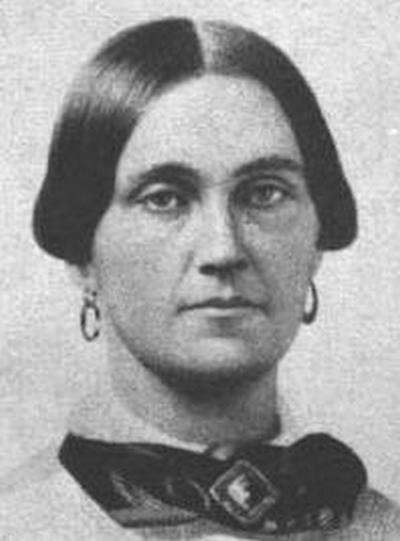
So many people wanted to be inside the Old Arsenal Penitentiary on July 7, 1865 that prison authorities issued tickets for admission.  Nearly 1,000 people crowded the courtyard, the buildings, even the top of the walls to face a gallows, constructed of raw lumber.  With the mid-day sun beating down on the scene, four prisoners were led from their cells and positioned on the gallows.  Each was fitted with a hood, or hanging cap, and a noose place around each of their necks.

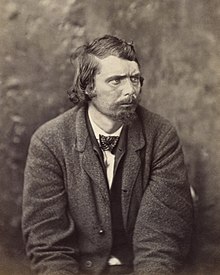
At 1:26 PM, the supports beneath the gallows were knocked away.  Lewis Powell, David Herold, George Atzerodt and Mary Surratt dropped through the trapdoors.  They dangled in their nooses for nearly 25 minutes before soldiers cut them down.  Doctors examined each body and pronounced all four conspirators dead.  They were buried in shallow graves next to the gallows.


Friday, July 6, 2012

Today in the Lincoln Conspiracy:  July 6

At mid-day on July 6, 1865, Mary Surratt learned she would hang the next day.  She erupted in wails of grief and sorrow.  Two Catholic priests, Jacob Walter and B.F. Wiget, went to her cell and tried to comfort her.  Anna Surratt also arrived, but her mother was inconsolable.  Mrs. Surratt was also suffering from severe menstrual distress and she was doubled over in pain.  The prison doctor prescribed wine and pain medication.  Outside her cell, in the prison courtyard, soldiers tested the gallows from which she would hang.  The priests and Anna remained at her side until the next morning.

Thursday, July 5, 2012

Today in the Lincoln Conspiracy: July 5

Marry Surratt
Following the conviction of the Lincoln conspirators on June 30, five of the nine military judges signed a letter to President Andrew Johnson, asking him to commute the death sentence imposed on Mary Surratt.  Judge Advocate General Joseph Holt delivered it to the president on July 5, 1865.  Johnson signed the execution order and did nothing about extending clemency to Mrs. Surratt.  The president later claimed he never saw the letter.  Holt disputed that account.  He said Johnson read the letter, then signed woman's death warrant, muttering that she "kept the nest that hatched the egg."

Later on July 5, soldiers began constructing a gallows at the Old Arsenal Prison, where the condemned were locked up.

Tuesday, June 26, 2012

Today in the Lincoln Conspiracy:  June 26

Two days after Gen. Robert E. Lee surrendered, President Lincoln spoke to a crowd of well-wishers at the White House.  During his remarks, Lincoln strongly made the case in favor of equal voting rights for newly freed slaves in the Southern states.  Among those listening was John Wilkes Booth.  He was so enraged by Lincoln's words that he declared it was the last speech the president would ever make.  But it wasn't the first time Lincoln had addressed the issue.  That had happened almost eight years earlier.

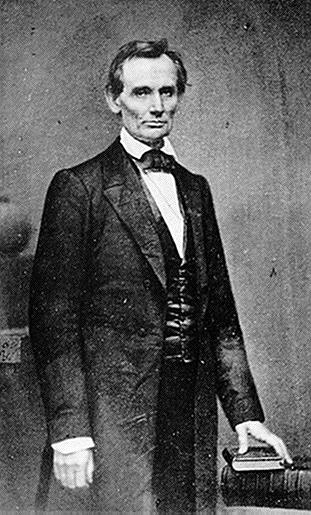
On June 26, 1857, Lincoln gave a speech in Springfield, Illinois harshly critical of the Supreme Court's Dred Scott decision.  Specifically, he was responding to a speech made at the same venue two weeks earlier by Stephen A. Douglas, the Democratic U.S. Senator from Illinois.  Douglas had endorsed the court's ruling that -- in essence -- African Americans had no rights guaranteed to them by the Constitution.  Lincoln presented a spirited counter-argument, by turns legal, philosophical and moral.  He concluded:

Abraham Lincoln, 1860
"The Republicans inculcate, with whatever of ability they can, that the negro is a man; that his bondage is cruelly wrong, and that the field of his oppression ought not to be enlarged. The Democrats deny his manhood; deny, or dwarf to insignificance, the wrong of his bondage; so far as possible, crush all sympathy for him, and cultivate and excite hatred and disgust against him; compliment themselves as Union-savers for doing so; and call the indefinite outspreading of his bondage 'a sacred right of self-government.'"

The next year, Illinois Republicans nominated Lincoln to challenge Douglas for re-election.  He lost.  Two years after that, Douglas and Lincoln faced off for the presidency.  Lincoln won.

Sunday, June 17, 2012

Today in the Lincoln Conspiracy:  June 18

Abraham Lincoln, attorney at law
Two decades before his ascent to the White House, Abraham Lincoln was a lawyer scrambling to establish his name and practice in Springfield, Illinois.  On June 18, 1840, he made his first appearance before the Illinois Supreme Court in the case of Scammon v. Cline.  He won.

Saturday, June 16, 2012

Today in the Lincoln Conspiracy:  June 16

Michael O'Laughlen
At the outbreak of the Civil War, Michael O'Laughlen joined the Confederate Army and served for about a year.  He was discharged in June of 1862 and returned to Baltimore, where he worked at his family's feed business.  On June 16, 1863, he took an oath of allegiance to the United States and filed a signed declaration with the U.S. Army in Baltimore.

Thursday, June 14, 2012

Today in the Lincoln Conspiracy:  June 14

The question of Lewis Thornton Powell's sanity consumed two days of testimony at the Lincoln conspiracy trial.  On June 14, 1865, Powell again submitted to an examination -- this time by the Surgeon-General of the United States Army, along with the previous witnesses, Dr. James C. Hall and Dr. Basil Norris, an Army surgeon.  Their verdict was unanimous.

Lewis Thornton Powell
"I have made an examination this morning of the prisoner, Payne [Powell's alias], and find no evidence of insanity—none whatever," concluded Surgeon-General J.K Barnes.  "I arrived at the conclusion that he is not insane," Dr. Norris concurred.  Dr. Hall, who had admitted there was evidence for "suspicion of insanity" the previous day, now felt otherwise.  "I think I am now prepared to say that there is no evidence of mental insanity," Hall told the court.  "Payne's mind is weak and uncultivated, but I can not discover any sufficient evidence of mental insanity."

Wednesday, June 13, 2012

Today in the Lincoln Conspiracy:  June 13

Most of what we know about conspirator Lewis Powell comes to us from testimony at the Lincoln assassination conspiracy trial.  The defense argued that he was insane and presented the testimony of two doctors to support the claim.

Lewis Powell at the Washington Navy Yard, 1865
On June 13, 1865, Dr. James C. Hall examined Powell in a small room off the main courtroom.  Later that day, he presented his findings to the military tribunal.  He testified that Powell was a man in a vigorous state of good health (except for a bout of constipation).  He also noted that the man's head was markedly asymmetrical, with the left side "much more developed than the right."  Hall asked Powell a series of questions, aimed at drawing him out and evaluating his mental faculties.

Hall testified that Powell had a sluggish memory and that he was slow to respond to simple questions.  The doctor told the court, "His mind is naturally dull and feeble, and, I presume, has not been cultivated by education."  Hall also asked Powell if a crime -- like the one with which he was charged -- could ever be justified morally.  Powell's response: "...in war a person was entitled to take life."  The doctor concluded, based on that answer, that there were reasonable grounds for a suspicion of insanity.  Under cross-examination, Hall admitted he was not prepared to declare Powell was, in fact, insane.  He protested that such a conclusion could only be based upon numerous examinations of the subject.  He said his single examination was, by necessity, too cursory to reach such a judgment.

The examination was cursory indeed.  During the course of his interview, Hall asked Powell for his mother's maiden name.  Powell said he couldn't remember.  Apparently, the doctor never asked the prisoner for his own name.  Throughout his testimony, Hall referred to him as "Payne", the alias Powell had adopted in order to enter war-time Washington.

Tuesday, June 12, 2012

Today in the Lincoln Conspiracy:  June 12

Ford's Theatre
The assassination of the president was a profound shock to the nation.  It was an even more profound shock to the employees of Ford's Theatre.  Several of them actually lived at the theater.  After the assassination, the building was under the control of the U.S. Army.  Employees were required to get passes from the military to stay in their own rooms.

On June 12, 1865, Ford's employee Louis J. Carland appeared before Lincoln conspiracy tribunal.  He testified that, on the night of the assassination, he went in search of Ned Spangler, the theater employee charged as a conspirator.  Carland went to the room of another theater hand, Jacob Ritterspaugh, to ask where Spangler had gotten off to.  Ritterspaugh was quite shaken, according to Carland.  The man said he had been backstage when President Lincoln was shot.  He had seen John Wilkes Booth dash across the stage and out the back door.  Ritterspaugh said he pointed out the fleeing figure to Spangler and said that it was Booth. 

According to Carland, Spangler slapped Ritterspaugh across the mouth.  Then he thundered, “You don’t know who it is; it may be Mr. Booth, or it may be somebody else.” 

Monday, June 11, 2012

The Plan:  John Wilkes Booth and the Plot to Destroy the U.S. Government

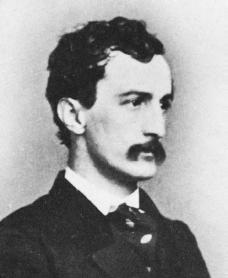
John Wilkes Booth
For generations, schoolchildren have learned that the assassination of Abraham Lincoln was the act of a deranged failed actor.  As we have seen, John Wilkes Booth was quite the opposite of a "failed actor".  He was one of America's biggest stars.  But surely he must have been out of his mind to attack Lincoln at Ford's Theatre.  The idea seems like madness, considered in isolation.

But Booth was not acting alone.

At the moment he entered the State Box at Ford's, he was convinced his fellow conspirators were taking coordinated actions that would paralyze -- perhaps even destroy -- the government of the United States.  Booth was a hothead, to be sure, and an egotist.  He imagined every state in the Confederacy would raise a statue of him after he struck his blow for Southern freedom.  But he wasn't irrational.  His actions were motivated by cold calculation and desperation, not madness.

Lewis Powell
This was the plan, then, for April 14, 1865.  Booth would got to Ford's Theatre, where he would kill President Lincoln and Union commander General Ulysses S. Grant.  Conspirator George Atzerodt would go to the Kirkwood House hotel, the home of Andrew Johnson, and kill the Vice President.  Conspirator Lewis Powell would go to the home of Secretary of State William Seward and kill him.


The plan was brilliant in its audacity. If successful, it would leave the United States government paralyzed, without its president, vice president, senior cabinet officer and general-in-charge of its army.  Their deaths would precipitate a full-blown constitutional crisis that would take days, if not weeks, to resolve. Booth and his conspirators could use the confusion to mask their getaway.  At least, that was the thinking behind the plan.

George Atzerodt
In actuality, things worked out quite differently.  Booth was operating on faulty intelligence.  General Grant did not accompany the president to the theater that night, so one of the targets escaped cleanly.  Atzerodt lost his nerve.  He took the revolver Booth had given him to kill Johnson and threw it in a gutter, then went off and got drunk.  Another target missed.  Powell came closer to success.  Claiming he was delivering medicine, he burst into Seward’s house, beat the secretary’s son, repeatedly slashed an army private who was there to guard the cabinet officer, then stabbed Seward so savagely everyone assumed he was dead.  A metal brace around Seward's neck saved his life.


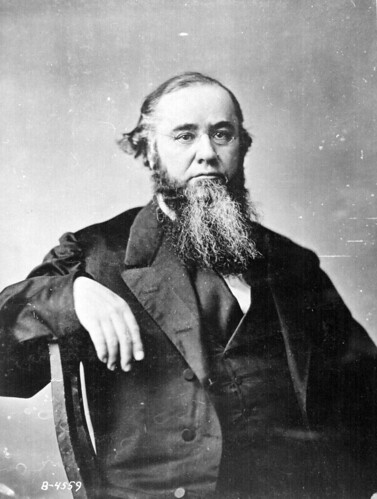
Secretary of War Edwin Stanton
The United States government, although stricken by the loss of its leader, was far from paralyzed.  Its response to the assassination was immediate and unrelenting.  War Secretary Edwin Stanton stepped into the power vacuum and launched a massive manhunt that would ultimately track down Booth, Atzerodt, Powell and six other conspirators.


Sunday, June 10, 2012

Today in the Lincoln Conspiracy: June 10

John Harrison Surratt Junior

Following the failed attempt to kidnap President Lincoln in March 1865, conspirator John Surratt fled Washington.  He made his way to New York, Canada, England and finally to Rome, where he joined the papal army.  In late 1866, Surratt was arrested in Alexandria, Egypt and extradited to the United States.

On June 10, 1867, Surratt went on trial in Maryland, charged with murdering Lincoln.  Unlike his mother Mary, he was judged by a civilian court.  The trial ended in a hung jury.

Saturday, June 9, 2012

Today in the Lincoln Conspiracy: June 9

Following the assassination of President Lincoln, Ford's Theatre was closed and turned over to the U.S. government.  It was used as office space for various federal agencies, including the Surgeon General and the War Department.


On June 9, 1893, the front section of the building collapsed, killing 22 War Department employees and injuring 68 more.  Despite being the scene of two deadly catastrophes, Ford's Theatre remained in government use until 1911.  It was fully restored and re-opened as a theater in January of 1976.

Friday, June 8, 2012

Today in the Lincoln Conspiracy: June 8

John Wilkes Booth
Conspirator John Surratt insisted that his involvement with John Wilkes Booth was limited strictly to a plan to abduct President Lincoln, not to kill him.  But testimony at the Lincoln assassination conspiracy trial casts doubt on that assertion.  Marcus P. Norton of Troy, New York, stayed at the National Hotel from January through March 1865.  He testified to the military tribunal that he witnessed several meetings Booth had with conspirators George Atzerodt and Michael O'Laughlen at the hotel.

George Atzerodt
He recalled one in particular.  It happened a day or two before Lincoln's second inauguration on March 4.  Booth and Atzerotd were sitting in the hotel's "rotunda office".  Norton was sitting nearby and could overhear their conversation.  He was probably eavesdropping, since he had seen Booth on stage many times.  Perhaps he was hoping to pick up some juicy tidbits of celebrity gossip.  Norton recounted that Booth and Atzerodt expressed hope that "the matter...with Mr. Johnson" would not succeed "as it did with Old Buchanan" or "their party would get terribly sold.". At the time, Norton admitted, he had no idea what the men were discussing.

On June 8, 1865, Norton told the military tribunal that the assassination of the president -- coupled with the attack on the Secretary of State and the bungled scheme to kill the Vice President -- brought that conversation back to his mind.  So what were Booth and Atzerodt talking about?

In 1857, a horrifying illness swept through the guests at the National Hotel -- twice.

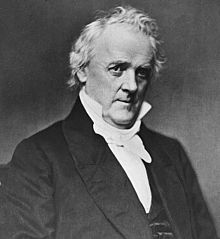
President James Buchanan
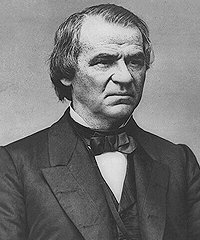
Vice President Andrew Johnson
On both occasions, President-elect James Buchanan had been in residence there.  The scuttlebutt in Washington was that someone had tried to poison Buchanan.  That was never proven, but was widely believed to be true.  If Norton heard correctly, it seems that Booth and Atzerodt were discussing an attempt on the life of Vice President Andrew Johnson and noting that if they didn't pull it off, things would go very badly for them.  The conversation took place two weeks before the conspirators tried -- and failed -- to kidnap Lincoln.  Based on Norton's testimony, it seems their plans at that time also included murder -- if not of the president, then of the vice president.

Wednesday, June 6, 2012

Today in the Lincoln Conspiracy:  June 6

What did Dr. Samuel Mudd know and when did he know it? For a century and a half, that question had been hotly debated among Lincoln conspiracy scholars.  An old friend of the doctor's made a damning assertion about Mudd's knowledge at the Lincoln conspiracy trial.

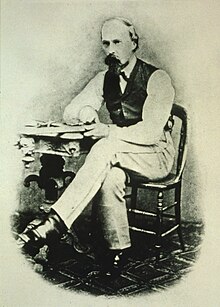
Dr. Samuel Mudd
Daniel J. Thomas, who claimed he had known Mudd since they were children, told the military tribunal that in March of 1865, he had a conversation with the doctor at the home of one of their neighbors in Bryantown, Maryland.  Thomas said that during the course of the conversation, he mentioned that South Carolina had fallen to Union forces and it appeared the Civil War would soon be over.  He said Mudd rejected the contention, then added, "the President, Cabinet, and other Union men in the State of Maryland would be killed in six or seven weeks."  At the time, Thomas thought Mudd was deadly earnest in his pronouncement.  He went so far as to send a letter to a local military commander recounting the conversation.  Over the next few days, however, he convinced himself Mudd was joking, since he had been a kidder all his life.

On June 6, 1865, Thomas faced blistering cross examination from the defense.  He denied that he had tried to claim a reward for providing information that led to Mudd's arrest.  He rejected a defense contention that he had asked soldiers to sign certificates that he had passed along the details of his conversation with Mudd before the doctor's arrest so he could collect $10,000 -- or even $25,000.  Under repeated questioning, however, Thomas did admit he told two soldiers they should sign certificates to that effect so he could cash in.  But, Thomas insisted, he was just joking.

Tuesday, June 5, 2012

Today in the Lincoln Conspiracy: June 5

The chief witness against the Lincoln conspirators was Louis J. Weichmann, a clerk at the War Department.

Louis J. Weichmann, witness for the prosecution

He had attended seminary with John Surratt Jr. and rented a room at Mary Surratt's boardinghouse in Washington.  He testified that the Surratt house was the hub of the conspiracy and most of its members had attended meetings there.  Weichmann himself had been detained for a time following President Lincoln's assassination because of his close ties to the Surratts.

After his testimony and the execution of the conspirators, Weichmann moved to Anderson, Indiana where he died on June 5, 1902.

Sunday, June 3, 2012

Today in the Lincoln Conspiracy: June 3

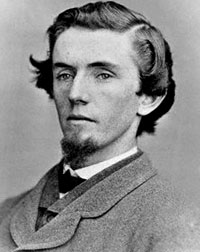
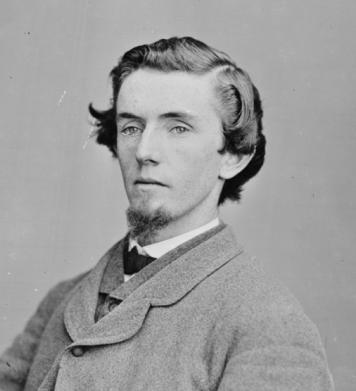
John H. Surratt Jr.
John Surratt did not face a military tribunal for his role in the Lincoln conspiracy.  He was safely out of the country when the trial took place.  However, the military judges heard testimony that seemed to link Surratt not just to the earlier attempt to kidnap the president, but to his assassination.

On June 3, 1865, a tailor named David C. Reed testified that he had seen Surratt outside the National Hotel at 2:30 in the afternoon on April 14th.  The National was, of course, where John Wilkes Booth was living at the time.  Surratt maintained he was nowhere near Washington when Lincoln was shot, and had no contact with Booth after April 3rd.

Reed would repeat his testimony nearly two years later when Surratt stood trial before a civilian court.  He insisted he immediately recognized Surratt.  Reed claimed he had known Surratt since he was a child.  He described Surratt's clothes and hair cut, said he was 30 to 35 years old and clean-shaven.  In fact, on April 14, 1865, Surratt had just turned 21 and wore a beard.

Saturday, June 2, 2012

Today in the Lincoln Conspiracy: June 2

Prosecutors at the trial of the Lincoln conspirators presented a great deal of testimony about the pro-Confederacy sentiments of the accused.  On June 2, 1865, E.L. Smoot told the military tribunal that Mary Surratt's brother, J.Z. Jenkins, was "an enemy to the Government during the struggle".  And he recounted a conversation he had with the bar-tender at the Surratt tavern in Maryland on the day President Lincoln died.

John H. Surratt Jr.
Smoot testified that Joseph T. Nott told him John Surratt was up to his neck in the conspiracy.  According to Smoot, the bar-tender said, "My God!  John knows all about the murder...I could have told you that thing was coming to pass six months ago."


Friday, June 1, 2012

"The History of the Nation Was Made There"

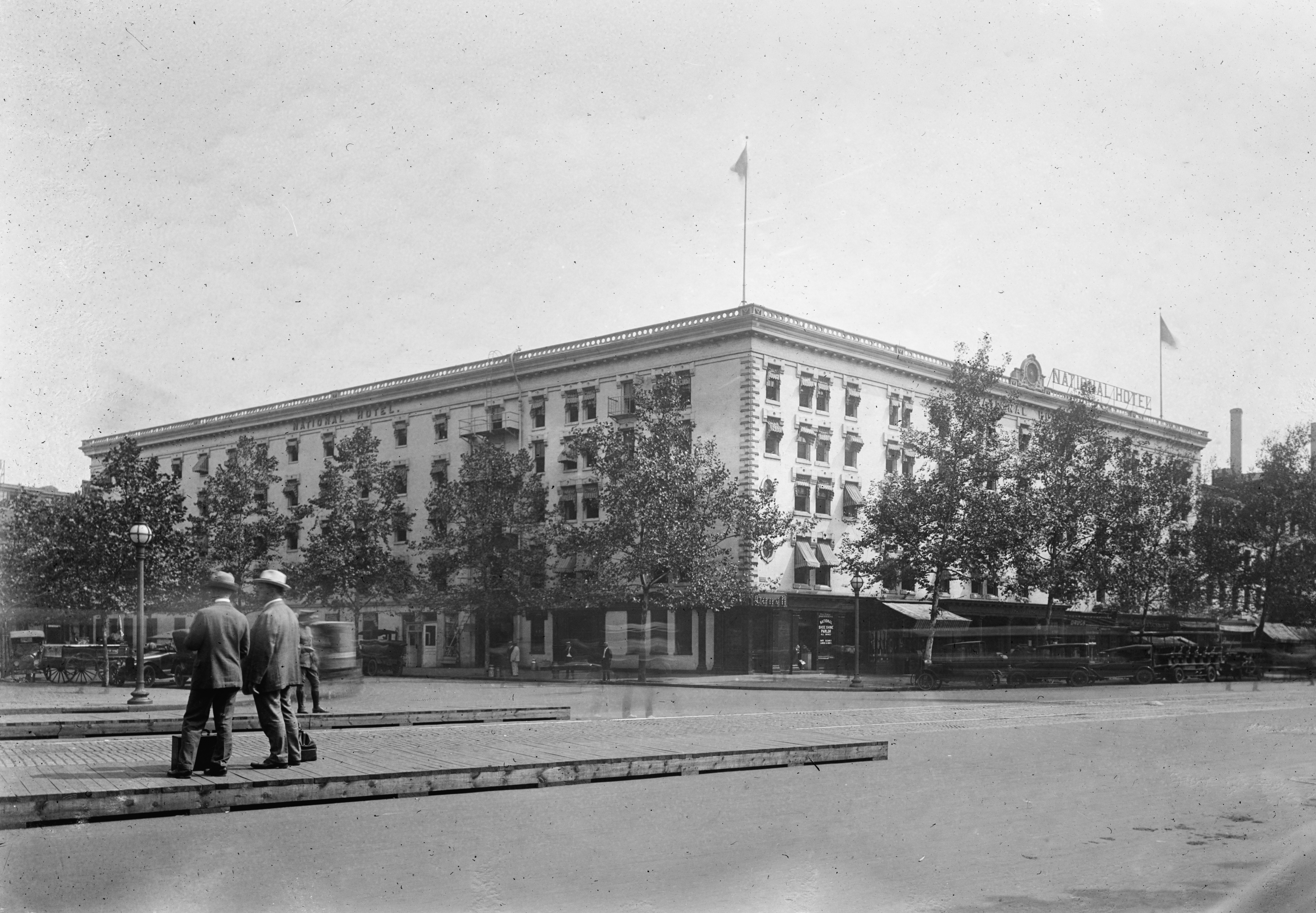
In 1865, the most fashionable address in Washington, D.C. was on the corner of Pennsylvania Avenue and 6th Street, NW.  There stood the center of Capitol society -- the National Hotel.  It had been the hub of Washington's political and social wheel since it opened in 1827.  The original owner, John Gadsby, started small.  He first built a collection of bungalows around a central courtyard.  Then he expanded the building until, by 1857, it stood as an imposing five-story edifice just four blocks from the U.S. Capitol and ten blocks from the White House.

The National Hotel

When the English writer Charles Dickens visited Washington in 1842, he stayed at the National. The great orator Henry Clay, who served as Speaker of the House (on three different occasions), U.S. Senator and Secretary of State, lived at the National for many years.  He died there in room 116.  Clay's nemesis Andrew Jackson stayed there too, as did President Polk.  Abraham Lincoln was also a guest at the hotel and held his inauguration banquet there.

In January of 1857. President-elect James Buchanan checked into the National.  During his stay, several of the guests became violently ill.  Some of them died.  When Buchanan left Washington, the illnesses stopped.  He checked back into the National just before his inauguration.  Once again, a mysterious illness swept through the hotel.  Buchanan heeded the advice of the locals and took his meals elsewhere.  After he moved into the White House, the illness again vanished.  Was someone trying to poison the new president?  No one knows.  The cause of the outbreaks was never determined (though a foul sewer opening in one corner of the building was considered a likely culprit).

During the Civil War, the office of the military's official news censor was in the National Hotel.  Senator John P. Hale of New Hampshire lived there with his family, including daughter Lucy.  In Room 228, Lucy's beau, John Wilkes Booth, plotted to bring down the United States government.

By all accounts, the National served its guest on a grand scale.  Its dining room was legendary for sumptuous dinners.  The hotel hosted balls, banquets and meetings of all sorts.  The Washington Post reported in 1930, “Apart from the Capitol and the White House, there is no building in this city so historic as this.  For more than half a century the history of the Nation was made there.” But times change. 

By the early 20th Century, the National was having trouble competing with its more contemporary and lavish neighbors, the Raleigh and the Willard.  In 1921, fire heavily damaged the National.  It never recovered.  The District of Columbia government bought the building in 1929, closed it in 1931 and tore it down 11 years later.


Thursday, May 31, 2012

Spinning the Web: John Wilkes Booth and the Lincoln Assassination Conspirators

David Herold
During the summer of 1864, John Wilkes Booth convinced two old friends, Samuel Arnold and Michael O'Laughlen, to join him in a plot to kidnap President Abraham Lincoln and hold him until the United States released thousands of captured Confederate soldiers.  Within months, Booth was actively recruiting other conspirators.

"Ned" Spangler
He enlisted a young drug store clerk named David Herold.  A native Marylander living in Washington with his widowed mother and a household full of sisters, Herold knew his way around Washington’s back alleys and Maryland’s back roads.  He also knew how to handle a gun.  Booth also renewed his acquaintance with Edmund (or Edman) "Ned" Spangler, who had once worked as a carpenter on the farm where Booth grew up. Spangler was a handyman at Ford’s Theatre.  Generous doses of the actor’s charm (plus generous doses of liquor) convinced him to run errands and do odd jobs for Booth.  While Spangler is often identified as a member of the conspiracy, it's quite likely he didn't really know what was going on and was little more than a “gofer” for his famous patron.

Dr. Samuel Mudd
By autumn 1864, after another trip to Montreal (and perhaps more contacts with the Confederate underground there), Booth took up more or less permanent residence in Washington.  He used his room at the elegant National Hotel as a base for his expanding operations.  He went for long rides in the Maryland countryside, sometimes claiming he was looking to buy horses or a piece of rural property.  In truth he was scouting potential escape routes.  He was also asking questions, learning who in the area supported the Confederate Cause and who was actively involved in clandestine Confederate operations.  On one such mission in November, he visited a Catholic church in Bryantown and was introduced to Dr. Samuel Mudd, a Southern sympathizer who also farmed, traded horses, bought and sold land.  Booth used Mudd as a sounding board about people living in the area.

John Surratt Jr.
Booth wanted to meet one of them in particular.  Along the way, someone somewhere whispered the name John Surratt in the actor’s ear.  Another native Marylander, Surratt ostensibly held a job at a Washington express company.  But after hours he quietly carried coded messages, led Confederate agents and directed smuggled medical supplies along the treacherous route from Canada to the Confederacy.  Surratt was in reality what Booth fancied himself to be – a bona fide agent of the Confederate secret service.  He was just the type of man Booth needed to pull all the loose ends of his plot together.

George Atzerodt
Surratt brought the last two conspirators into the fold.  George Atzerodt was a short, dumpy, ne’er-do-well most often described as “seedy.”  He lived in the Potomac River town of Port Tobacco (which also was his nickname), where he worked on carriages during the day.  At night he paddled a small boat across the Potomac, helping smugglers evade Union patrols.

Lewis Powell
Finally, there was one of the most enigmatic and fascinating members of Booth’s band – Lewis Thornton Powell.  A young former Confederate soldier with a strong chin, broad forehead, riveting stare and immense physical strength, he enlisted in a Florida infantry regiment early in the war.  He was wounded in 1862 and after his recovery, he returned to the Confederate Army until he was wounded again -- and captured by Union forces -- at Gettysburg.  He later escaped confinement and a murky 18-month period followed, during which he served under Col. John Singleton Mosby, the “Gray Ghost of the Confederacy.”  In January 1865 Powell arrived in Alexandria, Virginia and signed a loyalty oath to the Union under the alias Lewis Paine, the name history would remember him by for the next 140 years.


Louis J. Weichmann
Not everyone who was approached joined the conspiracy.  Actors Samuel Chester and John Matthews rebuffed Booth’s approaches and Dr. Mudd declined to take an active role.  Meantime, Surratt did his best to keep one man out of the plot – his roommate and former seminary classmate Louis J. Weichmann.  While he was a low-level employee in an obscure section of the War Department, Weichmann was also nosy and self-important.  He sensed Surratt was up to something but never figured out what it was.  (Later, after his own arrest, Weichmann would tell investigators he thought all secret comings and goings had something to do with Booth’s oil speculations.)

John Surratt was also responsible for another element of the conspiracy – a central location where the plotters could meet from time to time. He convinced his widowed mother Mary to open her boardinghouse at 541 H Street in Washington to his co-conspirators. There, frequent, unexplained comings and goings hardly seemed unusual.  The Surratt boardinghouse became the center of the conspirators' web.
Surratt Boardinghouse in Washington