Showing posts with label ford's theatre. Show all posts

Tuesday, June 12, 2012

Today in the Lincoln Conspiracy:  June 12

Ford's Theatre
The assassination of the president was a profound shock to the nation.  It was an even more profound shock to the employees of Ford's Theatre.  Several of them actually lived at the theater.  After the assassination, the building was under the control of the U.S. Army.  Employees were required to get passes from the military to stay in their own rooms.

On June 12, 1865, Ford's employee Louis J. Carland appeared before Lincoln conspiracy tribunal.  He testified that, on the night of the assassination, he went in search of Ned Spangler, the theater employee charged as a conspirator.  Carland went to the room of another theater hand, Jacob Ritterspaugh, to ask where Spangler had gotten off to.  Ritterspaugh was quite shaken, according to Carland.  The man said he had been backstage when President Lincoln was shot.  He had seen John Wilkes Booth dash across the stage and out the back door.  Ritterspaugh said he pointed out the fleeing figure to Spangler and said that it was Booth. 

According to Carland, Spangler slapped Ritterspaugh across the mouth.  Then he thundered, “You don’t know who it is; it may be Mr. Booth, or it may be somebody else.” 

Monday, June 11, 2012

The Plan:  John Wilkes Booth and the Plot to Destroy the U.S. Government

John Wilkes Booth
For generations, schoolchildren have learned that the assassination of Abraham Lincoln was the act of a deranged failed actor.  As we have seen, John Wilkes Booth was quite the opposite of a "failed actor".  He was one of America's biggest stars.  But surely he must have been out of his mind to attack Lincoln at Ford's Theatre.  The idea seems like madness, considered in isolation.

But Booth was not acting alone.

At the moment he entered the State Box at Ford's, he was convinced his fellow conspirators were taking coordinated actions that would paralyze -- perhaps even destroy -- the government of the United States.  Booth was a hothead, to be sure, and an egotist.  He imagined every state in the Confederacy would raise a statue of him after he struck his blow for Southern freedom.  But he wasn't irrational.  His actions were motivated by cold calculation and desperation, not madness.

Lewis Powell
This was the plan, then, for April 14, 1865.  Booth would got to Ford's Theatre, where he would kill President Lincoln and Union commander General Ulysses S. Grant.  Conspirator George Atzerodt would go to the Kirkwood House hotel, the home of Andrew Johnson, and kill the Vice President.  Conspirator Lewis Powell would go to the home of Secretary of State William Seward and kill him.


The plan was brilliant in its audacity. If successful, it would leave the United States government paralyzed, without its president, vice president, senior cabinet officer and general-in-charge of its army.  Their deaths would precipitate a full-blown constitutional crisis that would take days, if not weeks, to resolve. Booth and his conspirators could use the confusion to mask their getaway.  At least, that was the thinking behind the plan.

George Atzerodt
In actuality, things worked out quite differently.  Booth was operating on faulty intelligence.  General Grant did not accompany the president to the theater that night, so one of the targets escaped cleanly.  Atzerodt lost his nerve.  He took the revolver Booth had given him to kill Johnson and threw it in a gutter, then went off and got drunk.  Another target missed.  Powell came closer to success.  Claiming he was delivering medicine, he burst into Seward’s house, beat the secretary’s son, repeatedly slashed an army private who was there to guard the cabinet officer, then stabbed Seward so savagely everyone assumed he was dead.  A metal brace around Seward's neck saved his life.


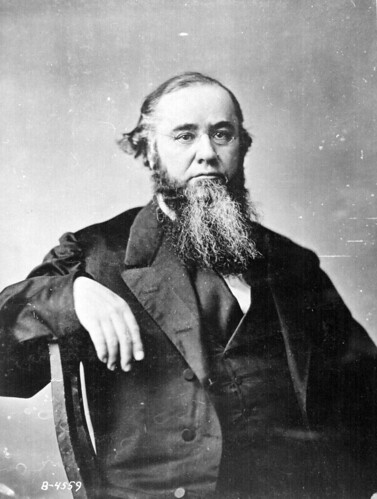
Secretary of War Edwin Stanton
The United States government, although stricken by the loss of its leader, was far from paralyzed.  Its response to the assassination was immediate and unrelenting.  War Secretary Edwin Stanton stepped into the power vacuum and launched a massive manhunt that would ultimately track down Booth, Atzerodt, Powell and six other conspirators.


Saturday, June 9, 2012

Today in the Lincoln Conspiracy: June 9

Following the assassination of President Lincoln, Ford's Theatre was closed and turned over to the U.S. government.  It was used as office space for various federal agencies, including the Surgeon General and the War Department.


On June 9, 1893, the front section of the building collapsed, killing 22 War Department employees and injuring 68 more.  Despite being the scene of two deadly catastrophes, Ford's Theatre remained in government use until 1911.  It was fully restored and re-opened as a theater in January of 1976.

Thursday, June 7, 2012

Today in the Lincoln Conspiracy:  June 7

During the Lincoln assassination conspiracy trial, prosecutors went to great lengths to paint Mary Surratt as an active member of the plot to kill the president.  Witness after witness described the fervid pro-Confederacy sentiments of Mrs. Surratt and members of her family.  They painted the Surratt boardinghouse in Washington as a nest of murderous vipers bent on destroying the United States.

Mrs. Surratt had three children.  Her elder son Isaac was a soldier in the Confederate Army.  Her younger son John was a Confederate spy who had schemed with John Wilkes Booth since the earliest days of the conspiracy.  Her middle child, Elizabeth Susanna (known as Anna), lived at the boardinghouse from November of 1864 until her mother's arrest.

Elizabeth Susanna "Anna" Surrattv
Defense lawyers called Anna as a witness to dispute testimony that her mother was consorting with the other conspirators.  She testified that both George Atzerodt and Lewis Powell (whom she knew under the name of "Wood") had visited the boardinghouse and had on some occasions stayed the night.  She said both men were there to see Lewis Weichmann, the War Department clerk who was the government's chief witness.

Anna Surratt also admitted she owned two photographs of John Wilkes Booth, whom she had met through her brother John.  She kept them hidden on the back of a painting given to her by Weichmann.  Anna told the tribunal her brother was furious when she bought them and demanded she tear them up.  She insisted that her acquaintance with Booth was casual, limited to a few brief encounters at the boardinghouse.

On June 7, 1865, a defense lawyer showed Anna a card bearing the state seal of Virginia.  She admitted she owned the card.  She testified a woman had given it to her two and a half years earlier.  Printed on the card was the state's motto, "Sic semper tyranis" -- the very words Booth shouted as he fled from Ford's Theatre the night he shot Abraham Lincoln.