Showing posts with label lewis weichmann. Show all posts

Thursday, June 7, 2012

Today in the Lincoln Conspiracy:  June 7

During the Lincoln assassination conspiracy trial, prosecutors went to great lengths to paint Mary Surratt as an active member of the plot to kill the president.  Witness after witness described the fervid pro-Confederacy sentiments of Mrs. Surratt and members of her family.  They painted the Surratt boardinghouse in Washington as a nest of murderous vipers bent on destroying the United States.

Mrs. Surratt had three children.  Her elder son Isaac was a soldier in the Confederate Army.  Her younger son John was a Confederate spy who had schemed with John Wilkes Booth since the earliest days of the conspiracy.  Her middle child, Elizabeth Susanna (known as Anna), lived at the boardinghouse from November of 1864 until her mother's arrest.

Elizabeth Susanna "Anna" Surrattv
Defense lawyers called Anna as a witness to dispute testimony that her mother was consorting with the other conspirators.  She testified that both George Atzerodt and Lewis Powell (whom she knew under the name of "Wood") had visited the boardinghouse and had on some occasions stayed the night.  She said both men were there to see Lewis Weichmann, the War Department clerk who was the government's chief witness.

Anna Surratt also admitted she owned two photographs of John Wilkes Booth, whom she had met through her brother John.  She kept them hidden on the back of a painting given to her by Weichmann.  Anna told the tribunal her brother was furious when she bought them and demanded she tear them up.  She insisted that her acquaintance with Booth was casual, limited to a few brief encounters at the boardinghouse.

On June 7, 1865, a defense lawyer showed Anna a card bearing the state seal of Virginia.  She admitted she owned the card.  She testified a woman had given it to her two and a half years earlier.  Printed on the card was the state's motto, "Sic semper tyranis" -- the very words Booth shouted as he fled from Ford's Theatre the night he shot Abraham Lincoln.

Tuesday, June 5, 2012

Today in the Lincoln Conspiracy: June 5

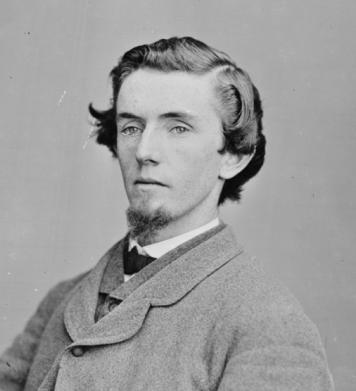
The chief witness against the Lincoln conspirators was Louis J. Weichmann, a clerk at the War Department.

Louis J. Weichmann, witness for the prosecution

He had attended seminary with John Surratt Jr. and rented a room at Mary Surratt's boardinghouse in Washington.  He testified that the Surratt house was the hub of the conspiracy and most of its members had attended meetings there.  Weichmann himself had been detained for a time following President Lincoln's assassination because of his close ties to the Surratts.

After his testimony and the execution of the conspirators, Weichmann moved to Anderson, Indiana where he died on June 5, 1902.

Thursday, May 31, 2012

Spinning the Web: John Wilkes Booth and the Lincoln Assassination Conspirators

David Herold
During the summer of 1864, John Wilkes Booth convinced two old friends, Samuel Arnold and Michael O'Laughlen, to join him in a plot to kidnap President Abraham Lincoln and hold him until the United States released thousands of captured Confederate soldiers.  Within months, Booth was actively recruiting other conspirators.

"Ned" Spangler
He enlisted a young drug store clerk named David Herold.  A native Marylander living in Washington with his widowed mother and a household full of sisters, Herold knew his way around Washington’s back alleys and Maryland’s back roads.  He also knew how to handle a gun.  Booth also renewed his acquaintance with Edmund (or Edman) "Ned" Spangler, who had once worked as a carpenter on the farm where Booth grew up. Spangler was a handyman at Ford’s Theatre.  Generous doses of the actor’s charm (plus generous doses of liquor) convinced him to run errands and do odd jobs for Booth.  While Spangler is often identified as a member of the conspiracy, it's quite likely he didn't really know what was going on and was little more than a “gofer” for his famous patron.

Dr. Samuel Mudd
By autumn 1864, after another trip to Montreal (and perhaps more contacts with the Confederate underground there), Booth took up more or less permanent residence in Washington.  He used his room at the elegant National Hotel as a base for his expanding operations.  He went for long rides in the Maryland countryside, sometimes claiming he was looking to buy horses or a piece of rural property.  In truth he was scouting potential escape routes.  He was also asking questions, learning who in the area supported the Confederate Cause and who was actively involved in clandestine Confederate operations.  On one such mission in November, he visited a Catholic church in Bryantown and was introduced to Dr. Samuel Mudd, a Southern sympathizer who also farmed, traded horses, bought and sold land.  Booth used Mudd as a sounding board about people living in the area.

John Surratt Jr.
Booth wanted to meet one of them in particular.  Along the way, someone somewhere whispered the name John Surratt in the actor’s ear.  Another native Marylander, Surratt ostensibly held a job at a Washington express company.  But after hours he quietly carried coded messages, led Confederate agents and directed smuggled medical supplies along the treacherous route from Canada to the Confederacy.  Surratt was in reality what Booth fancied himself to be – a bona fide agent of the Confederate secret service.  He was just the type of man Booth needed to pull all the loose ends of his plot together.

George Atzerodt
Surratt brought the last two conspirators into the fold.  George Atzerodt was a short, dumpy, ne’er-do-well most often described as “seedy.”  He lived in the Potomac River town of Port Tobacco (which also was his nickname), where he worked on carriages during the day.  At night he paddled a small boat across the Potomac, helping smugglers evade Union patrols.

Lewis Powell
Finally, there was one of the most enigmatic and fascinating members of Booth’s band – Lewis Thornton Powell.  A young former Confederate soldier with a strong chin, broad forehead, riveting stare and immense physical strength, he enlisted in a Florida infantry regiment early in the war.  He was wounded in 1862 and after his recovery, he returned to the Confederate Army until he was wounded again -- and captured by Union forces -- at Gettysburg.  He later escaped confinement and a murky 18-month period followed, during which he served under Col. John Singleton Mosby, the “Gray Ghost of the Confederacy.”  In January 1865 Powell arrived in Alexandria, Virginia and signed a loyalty oath to the Union under the alias Lewis Paine, the name history would remember him by for the next 140 years.


Louis J. Weichmann
Not everyone who was approached joined the conspiracy.  Actors Samuel Chester and John Matthews rebuffed Booth’s approaches and Dr. Mudd declined to take an active role.  Meantime, Surratt did his best to keep one man out of the plot – his roommate and former seminary classmate Louis J. Weichmann.  While he was a low-level employee in an obscure section of the War Department, Weichmann was also nosy and self-important.  He sensed Surratt was up to something but never figured out what it was.  (Later, after his own arrest, Weichmann would tell investigators he thought all secret comings and goings had something to do with Booth’s oil speculations.)

John Surratt was also responsible for another element of the conspiracy – a central location where the plotters could meet from time to time. He convinced his widowed mother Mary to open her boardinghouse at 541 H Street in Washington to his co-conspirators. There, frequent, unexplained comings and goings hardly seemed unusual.  The Surratt boardinghouse became the center of the conspirators' web.
Surratt Boardinghouse in Washington

Sunday, May 27, 2012

Today in the Lincoln conspiracy: May 27

The lawyers representing the Lincoln assassination conspirators faced many hurdles.  Their clients were being judged by a military tribunal, not a civilian court.  The defendants were not permitted to speak on their own behalf.  And they were accused of plotting to kill the Commander-in-Chief that each member of the tribunal had served.  Defense attorneys were fighting an uphill battle.  Even so, they didn't always cover themselves in glory.

Take, for example, the testimony of Augustus Spencer Howell.  The attorney representing Mary Surratt called Howell to the witness stand on May 27, 1865.  The purpose of his testimony, apparently, was to cast doubt on the star prosecution witness, Louis Weichmann.  Howell testified he and Weichmann were both staying at the Surratt boardinghouse the previous February.  He claimed Weichmann professed his sympathies for the Confederate cause and even proclaimed his intention of moving to Richmond and getting a job in the Confederate War Department.  It was a startling accusation, considering Weichmann was a clerk at the United States War Department and a member of the home guard unit charged with protecting Washington from Southern attack.  Howell seemed to be suggesting Weichmann was some sort of secret Confederate agent, deep in the heart of the U.S. government.

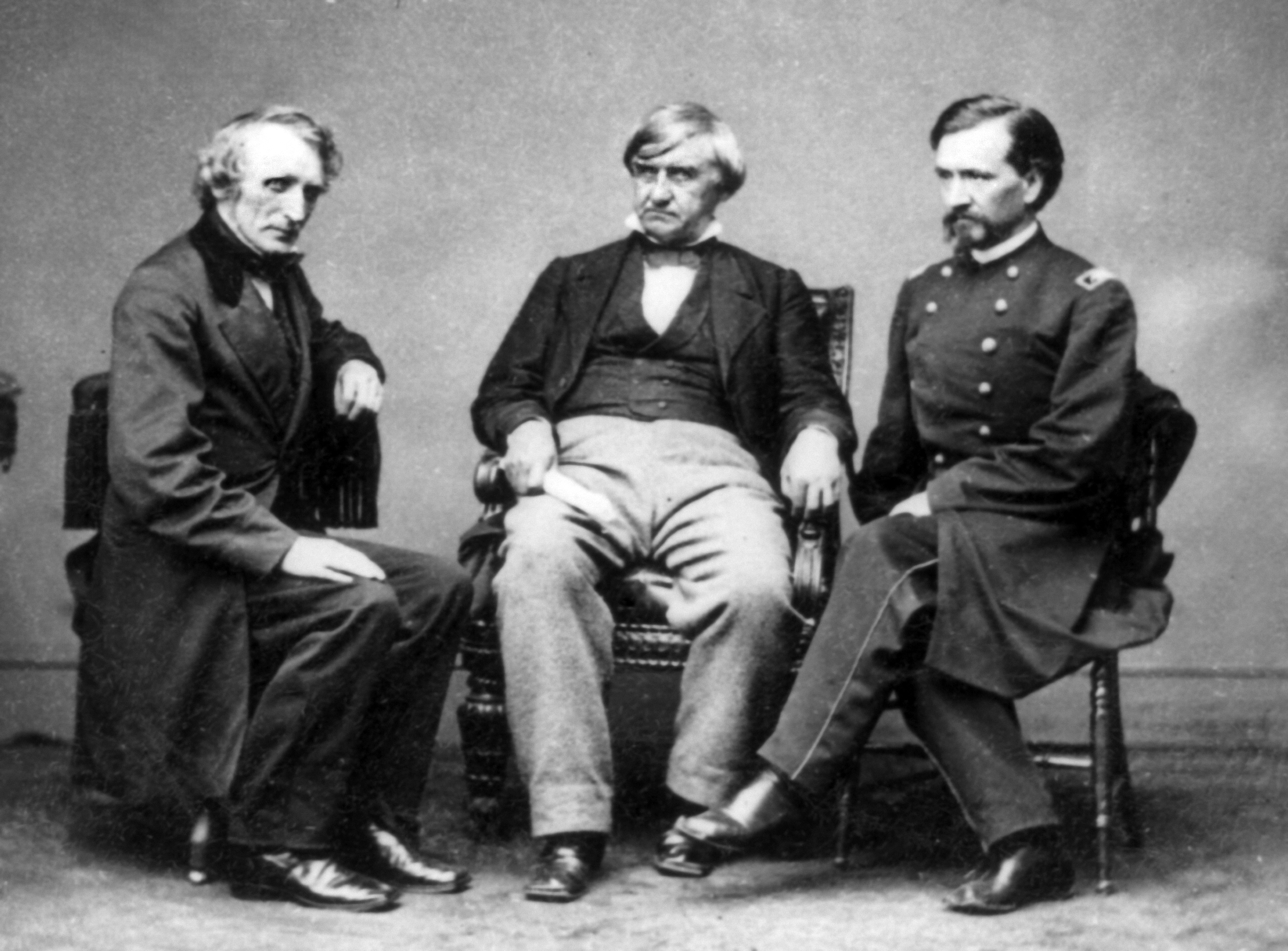
The prosecution team, Gen. Henry Burnett on the right
The prosecution pounced.  Brigadier General Henry Burnett, the assistant judge advocate for the case, asked Howell, "What has been your business for the last year and a half?"  It seemed a harmless, routine inquiry.  But the defense vigorously objected.  When the court overruled the objection and the question was repeated, the defense objected again.  The court overruled it again.  What was it the defense was trying to keep out of the trial record?

Howell, it turns out, was a blockade runner.  He made several trips across the Potomac River, accompanying people to and from the Confederate capital of Richmond.  Howell denied he smuggled supplies, and denied acting as a courier.  But he admitted visiting Richmond every few months during the early years of the war.  And he had even made a trip to Richmond the previous February -- just days after he stayed at the Surratt boardinghouse.  Needless to say, Howell's testimony didn't carry a lot of weight with the tribunal.