Twisted Roots: The Family of John Wilkes Booth
The short life of John Wilkes Booth is filled with drama, not all of it on stage. Indeed, his personal story reads like fiction, from his birth as the son of a theater legend to his death as the most wanted man in America.
 |
| Junius Brutus Booth |
His father, Junius Brutus Booth, is a towering figure in the history of
the American stage. Within months of his 1821 debut in the United
States, the British-born tragedian was hailed as the greatest
classical actor in the country, even though he was only in his
mid-twenties. He settled in Baltimore and invested his growing fortune
in a 150-acre spread in rural Maryland, which he dubbed "The Farm".
There, he and Mary Ann Holmes would raise their children.
The elder Booth was universally regarded as brilliant. He was also
universally regarded as “difficult”. He was prone to deep bouts of
what we now know to be depression. He was also given to behavior
characterized, charitably, as eccentric – crowing like a rooster
from a theater balcony during a love scene, or strolling naked down a
city street. And his capacity for liquor achieved legendary status.
Theater owners tried to control his access to alcohol, sometimes
locking him in a hotel room between performances in the hope of
maintaining his sobriety. Booth overcame such obstacles, in one
instance by pushing a straw through the keyhole in his hotel room
door to sip from a bottle on the other side.
 |
| Mary Ann Holmes Booth |
Back at "The Farm", Mary Ann presided over a growing brood of
children. She would give birth to ten, six of whom survived childhood.
The ninth entered the world on Thursday, May 10, 1838. He was named in
honor of an English Member of Parliament who was a vocal supporter of
American Independence. John Wilkes Booth, like Abraham Lincoln, was
born in a log cabin.
The younger Booth and all his siblings were prohibited from attending
his father’s plays. Even so, the household was steeped in the
traditions of the classical theater and the figure of the
often-absent Junius Brutus towered over it. The children and their
mother spent summers on "The Farm" (later expanded and re-named "Tudor
Hall") and winters in Baltimore.
It was in the city, when John Wilkes Booth was just eight years old,
that a real-life drama shook the foundation of the Booth family. A
young man arrived, claiming to be the son of the country’s most
prominent actor. Local residents dismissed his claim, since the Booth
family was well known in Baltimore. What they didn’t know was Junius
Brutus had left a wife and son behind in Europe.
The young man summoned his mother. Adelaide Delannoy Booth was so
incensed to learn of her husband’s second life, she booked passage
on the first ship to America. It sank. Undeterred, she jumped on the
next available ship and finally arrived in Maryland to lay claim to
her son’s birthright. Once in Baltimore, Adelaide learned her
husband was not only famous, but also prosperous. She wrote her
sister in Brussels, “I don’t want to do anything to prevent him
from making money, so I shall wait till he returns… then my lawyers
will go off on him like a bomb.”
 |
| Tudor Hall, the Booth country home, was constructed by the same contractor who built Ford's Theatre |
The truth finally came out, aided by the rightful Mrs. Booth
parading up and down before the Booth house on Exeter Street,
screaming that the children inside were “bastards”. One can
imagine the trauma such a display caused the young John Wilkes. To
his credit, Junius Brutus had consistently provided financial support
for the wife and son he had abandoned to run off with Mary Ann Holmes
(who was a flower girl outside a London theater when they met).
 |
| Junius Brutus Booth with son Edwin, age 13 |
It took two years for the shocking drama to unfold. Adelaide
finally agreed to a divorce, paving the way for Junius Brutus and
Mary Ann to wed on May 10, 1851 – John Wilkes Booth’s thirteenth
birthday. A year and a half later, Junius Brutus Booth was dead, the apparent victim of his own excesses.

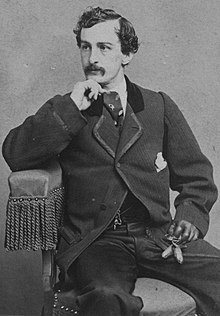 But the evidence is clear that the youngest of the acting Booth brothers was a shining star of his age. It's instructive to note that at the beginning of his May 1862 engagement at the Boston Museum, his name appears at the bottom of the handbills promoting each play. By the end of the run, the name "J. Wilkes Booth" was emblazoned across the top.


